
Photo courtesy of nytimes.com
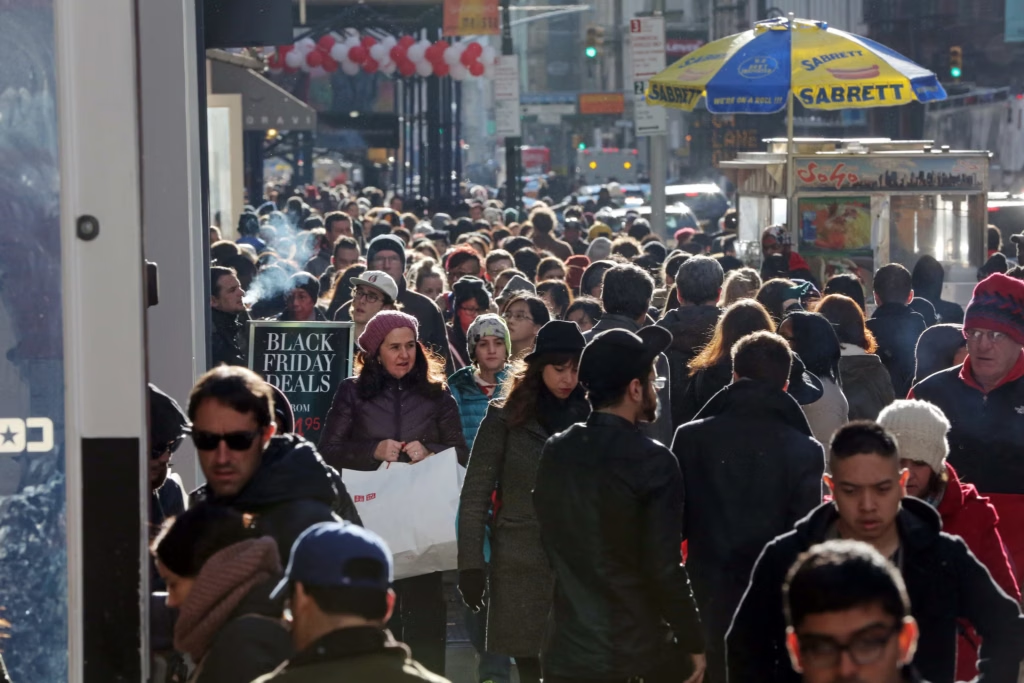
It’s three AM in the morning, and the air is buzzing with excitement. Your entire family eagerly rushes down the stairs and piles into the car, ready for a long day of waiting and shopping. When you arrive at your destination, a gigantic line stretches around the corner, and hundreds of families and friends are chatting about what they will buy, excitedly waiting for the mall doors to open at six AM sharp.
Black Friday is widely known throughout pop culture for its massive retail sales and widespread hysteria. Some say the concept originated with two Wall Street financiers, Jay Gould and Jim Fisk, who wanted to buy all of the country’s gold to sell it at an extremely high price and make a large profit. Their actions were supposedly a response to the crashing U.S. gold market in 1869. In reality, Philadelphia police officers coined the term “Black Friday” during the 1960s when floods of tourists would come and begin their holiday shopping, and also attend the annual Army-Navy football game. This time of year became extremely chaotic, but in an attempt to put a positive spin on it, city shopowners began calling it “Big Friday.” It was later converted to “Black Friday” to signify that companies were going to turn a large profit, hence “putting them in the black.” From then on, Black Friday became one of the busiest, most profitable shopping days in the U.S.
Numerous stories from the 2000s describe the countless lines out the door, pushing and shoving over an item, and even people camping overnight just to get the product of the year. Its close connection to the holiday season also heightens the craze in the retail industry while also creating lasting memories for loved ones all around the nation.
Many teachers at EA fondly recall their own stories around the occasion. Stephen Morris, Upper School math teacher, describes his family’s experiences with Black Friday: “They would leave at one in the morning to go get in line at a Walmart or at a Best Buy or at some toy store because they wanted to be the first one in, and they loved it.” Remembering his family’s excitement for Black Friday, he explains how important it was to them to wake up early and beat the crowds. Morris would ask his family, “Can’t you just wait until ten in the morning and just go shopping?” to which they said, “No, this is gonna be so great.” Morris additionally notes, “It was just energy about it. And they would come back with funny stories to tell. So for them it’s kind of like a memorable moment, and they loved it”
Anna McDermott, Upper School history teacher, describes her own experiences of the special occasion with her children: “Every year, you know, when they were little, it was like the highlight of their life. I used to get up with my boys and just go to Target and say, whatever you want, just buy it, put it in the basket. You’re in Target, and how many times did your parents say, ‘Nope, you can’t get anything?’ They were really cute about it.”
Upper School math teacher Jay Jennings also recalls his story of waiting in line for the Xbox One as a gift for his son. “ I stayed up the whole night, so from twelve o’clock on Thanksgiving, I stood in line until six am the next morning, about 20 hours. My wife brought me food while I was standing in line. But it was fun. So I enjoyed the sort of thrill of the hunt,” he explains
Kris Aldridge, Upper School history teacher, recalls her time while being a mother during the teenage craze of Black Friday. “I have four children and two of them, my daughters, had this habit, probably for the better part of like, eight years of going to the King of Prussia Mall when it opened, I think, at six AM on Black Friday. We would get up and stand in line right outside the Nordstrom entrance. You know, and when they open the doors, we’d go running in,” she shares.

Photo courtesy of The Guardian
Recently, though, Black Friday shopping has drastically shifted to a more online-centered presence, which has caused many malls and stores to face the problem of decreased foot traffic. On Black Friday specifically, the number of in-person shoppers has drastically decreased compared to the 2000s and 2010s. People no longer line up early in the morning or sprint into stores to get what they want. Now, the majority of people choose to stay at home with their laptops propped open, clicking buttons instead of driving to the mall. Cristina Deirmengian, Upper School Spanish teacher, reflects negatively on this, remarking, “You get addicted, and you just keep on buying and buying and buying even if you don’t really know it. Because you don’t give your credit card or money, and it’s just a click, so it feels like nothing, but then the bills go.”
Many EA teachers comment on how this shift has changed the idea of “Black Friday” as a whole. “Black Friday has been watered down. They don’t give a special sale anymore,
It’s all month now, so it’s almost like it’s not even existing.” McDermott shares. Aldridge also agrees on this, claiming, “I think with particular respect to Black Friday, I think you miss the point. Why are you doing it on Black Friday? Just do it Saturday, Sunday, Monday, right? I think the point of Black Friday was that it was this great ceremony. Now it’s like a week, two weeks. And I also feel like if you’re paying attention, there are so many sales constantly anyway now.” Both McDermott and Aldridge agree that Black Friday, with its online persona, has lost its meaning and become jumbled up with other ordinary sales. It no longer brings the big excitement of getting up early and hunting for the best deals.
Though Black Friday has slowly started to shift online, it continues to provide family and friends with opportunities for new memories and experiences. Jennings explains how the online switch has also aided Black Friday. “I think the people who were looking for the deals were a small band of people. And so I think by shifting it, they’re trying to get a wider audience, so more people can have access to the deals and the sales, especially for the younger audience.” Jiya Naik ’28 shares her opinion, “There’s always a really big crowd. All of the stores are so tiny, and it gets really congested, ” but also adds a positive to the in-person experience, “You can try on clothes, [and] see if they fit you.” Faye Mo ’29 adds, “I prefer online Black Friday shopping because you don’t have to go [to] as many places, you [don’t] have to wait in lines, and it’s just a lot faster to find what you want.” By promoting Black Friday largely online, it encourages the new generation of people to continue enjoying the event that has been celebrated for many years. Black Friday will always play a big part in the holiday season as an opportunity for excitement and bonding shared by loved ones. Whether or not the in-person aspect is slowly losing its spark, Black Friday will always be a part of some of the most cherished memories for thousands across the nation.