

SILENT WARD: Missile strikes have decimated Iranian hospitals.
Photo courtesy of Al Jazeera
As of April 19, tensions involving the United States, Iran, Israel, and regional allies have escalated into a rapidly developing international conflict. What initially began as joint U.S.-Israeli missile strikes that utterly decimated Iran’s senior leadership—including Ayatollah Ali Khamenei, Iran’s Supreme Leader—has expanded into a broader military and political crisis, raising concerns about global stability, economic security, and the direction of current U.S. foreign policy. As new developments emerge, the situation continues to raise questions about its potential impact both globally and domestically
Initial U.S.-Israeli missile strikes on February 28 prompted immediate retaliatory attacks from both Iran and neighboring allies, such as the Iranian-backed militant group Hezbollah based in Lebanon. On March 8, Mojtaba Khamenei, son of Iran’s recently slain leader, assumed the position of Iran’s new Supreme Leader. Over the course of the following weeks, the United States continued its attacks on key Iranian military sites, seeking to cripple the country’s nuclear capabilities. The United States military also damaged critical infrastructure such as bridges and power plants in Iran—even those with no apparent military use. In early to mid-March, Iran restricted access to the Strait of Hormuz, a narrow yet critical waterway through which roughly 20% of the world’s oil supply passes, sending energy prices surging throughout the world. After weeks of fighting and casualties sustained on both sides, Iran and the U.S. agreed to a tenuous two-week ceasefire, while also agreeing to open the Strait of Hormuz after a separate ceasefire in Lebanon.
As the duration of the war has progressed past many initial estimates and expectations, critics have increasingly questioned the president’s core objectives regarding the war. “I think it’s very unfortunate that we’re losing U.S. military and Iranian civilians for a war where we’re not really sure what we’re fighting for,” says Tracy Motley, faculty advisor for the Young Democrats Club. Potential justifications for the war have at times seemed to vary day-to-day, ranging from seeking regime change, reducing Iran’s role as a regional power, to reopening the Strait of Hormuz. “I don’t think the aims were ever really well defined in the first place,” says Daniel Adibi ’26.
Furthermore, whether the U.S.’s attacks will ultimately benefit the Iranian people has become yet another topic of debate. On one hand, by toppling the ringleaders of a brutal and totalitarian regime, one that had viciously suppressed waves of anti-government protests earlier this year, U.S. missile strikes could potentially serve as the impetus for expanded civil liberties and increased political participation for Iranian citizens. However, many believe that the U.S.’s continued onslaught of bombardments and strikes has only alienated a potentially sympathetic Iranian public, while failing to stymie the extremist tendencies of the Iranian government. Charlie Casey ’27 says, “Were it to end today, the people of Iran would find themselves worse off than they were before the war… [the government] has replaced themselves with people who are just as, or sometimes even more strict and more oppressive.” Adibi shares these sentiments, drawing parallels between Iran and Venezuela’s political upheavals: “If you look at Venezuela, a lot of people were very happy when Maduro was taken, but if you look at the actual situation, the same government structure is still going to be in place. With the Iran situation, a lot of people were hopeful for regime change, but the same government structure is going to remain in place.” Adibi adds, “If somebody comes in and interferes with your system, you’re going to view the person who interfered unfavorably even if you didn’t support the original government. I don’t think [the war] is going to do a net positive in terms of increasing U.S. favorability.”
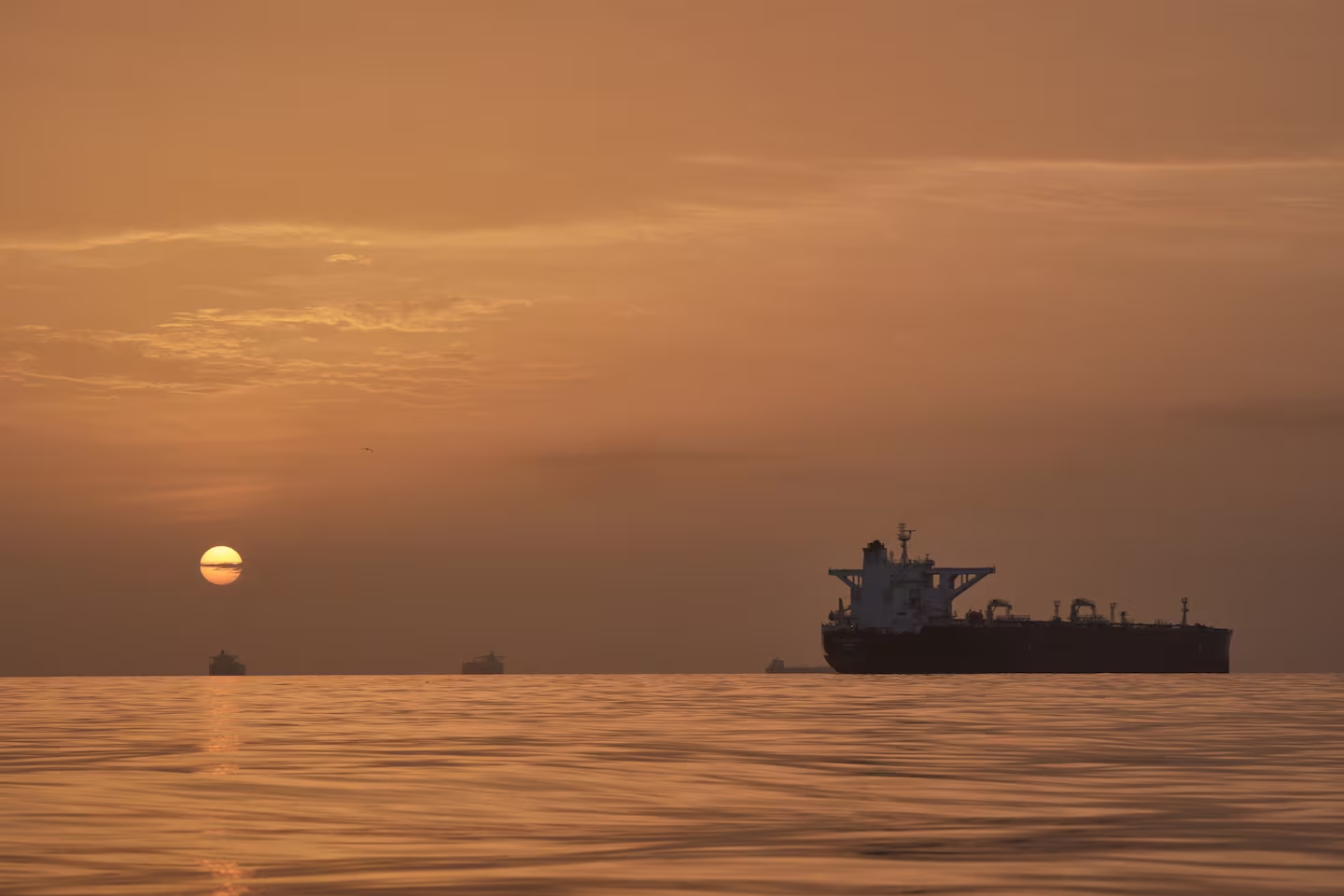
DIRE STRAIT: The closure of the Strait of Hormuz has drastically
impacted global markets and energy prices.
Photo courtesy of The Washington Post
Within America, the war in Iran has become yet another flashpoint in the nation’s polarized and volatile political climate. This time, however, criticism has emerged even from traditional conservatives and other supporters of President Trump. Former Fox News host Tucker Carlson and U.S. Representative Marjorie Taylor Greene, along with far-right conspiracy theorists such as Candace Owens, have all spoken out against the extent of U.S. involvement in Iran. Regarding these divisions that have begun to emerge from a seemingly bulletproof constituency, Casey says, “This is devastating for his domestic approval. He was already pretty underwater for the midterms. Now it’s going to be even more so night and day. If this compounds with the Epstein list debacle, he’s absolutely cooked.”
Much of the consternation targeted at the current presidency has been a direct result of the president’s inflammatory social media posts. On April 5, Trump posted onto Truth Social, “Open the [ ] Strait, you crazy bastards, or you’ll be living in Hell — JUST WATCH! Praise be to Allah.” Furthermore, on the morning of April 7, before Trump’s given deadline for Iran to reach an agreement with the U.S., he claimed, “a whole civilization will die tonight.” His comments, interpreted by some as threatening nuclear war and genocide, spurred calls from both political parties for his removal via the 25th Amendment.
Members of the EA community have viewed Trump’s social media posts as an egregious breach of the etiquette and civility befitting the nation’s highest office. Casey says, “Quite frankly, I can find no words to dress it up other than appalling and disturbing because to openly advocate genocide, raking the good names of Christianity and Islam through the mud [is] sickening.” Upper School world religions teacher Michael Sheehan ’04 adds, “The Persian and Iranian civilizations have been around for centuries, and to insinuate that at your whim, all of that could come crashing down and not take into account, not only the incredibly tragic human loss that that would be, but the cultural, historical, and social loss, is … I can’t even compute it. It’s unfathomable.”
Reactions to the ceasefire have similarly varied across EA, ranging from pessimism to relief. Michael Whalen ’08, faculty advisor for the Young Republicans Club, remarks, “It will be temporary. I don’t think anything’s gonna really come with it.” On the other hand, the stoppage has given others a precious break from the chaos and bloodshed of war. Zachary Richards, Upper School ethics teacher, says, “War for me should always be the last resort. We should be doing anything and everything we can to avoid that. That’s why, if we pause to have a negotiation, I’m all for it, because that gives us a chance to stop with the killing, and to actually have some meaningful discussions, to make some progress, to come to an agreement.”
Though the war in Iran is far from over—with diplomats from both Iranian and American delegations scrambling to find terms favorable for both sides—it continues to function as a reminder of the strained state of geopolitics today. National, ethnic, and ideological rivalries feel at times combustible, ready to flare into a global conflict at a moment’s notice, ensnaring reluctant allies and critical power supplies within its grasp. Moreover, the war, regardless of how it eventually concludes, will have lasting implications for global energy markets, U.S. credibility, and the lives of millions of Iranians.