Photo courtesy of Kamau Kegler ’ 27
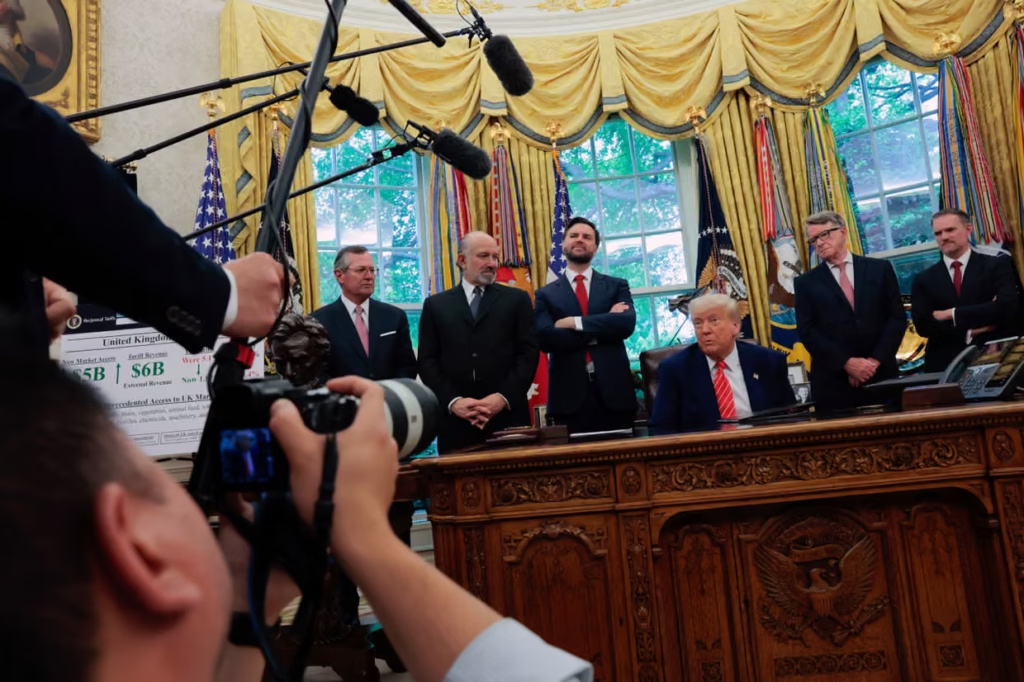
One of the founding principles of this nation, so important that it is written into the Constitution—its most defining text—is the freedom of speech. The First Amendment guarantees our right to speak our minds on topics around the world without fear of government punishment. However, the recent actions of the Trump Administration suggest that the president believes freedom should have limits. On September 18, CNN, MSNOW, and Politico were banned from the White House by the administration, citing “reporting fake news” as the justification. Although U.S. District Judge Timothy Kelly blocked the order and the precedent’s implications, the attempt marked the President’s will to invade the rights of journalism.
The Trump Administration has often criticized negative press coverage. On August 30, President Donald Trump posted on Truth Social, his self-owned news platform, accusing NBC reporter Kristen Welker of “purposeful inaccuracies” after she said his endorsed candidates had “mixed results.” He then said she would be “reported for rebuke or punishment” by the Federal Communications Commission, which monitors all state and interstate news. NBC News, however, stands by Welker and her reporting.
While the FCC can monitor public airwaves such as radio, traditionally, it has had far less power over news networks, with no authority to punish journalists due to First Amendment protections. Young Independents faculty advisor and Upper School history teacher Dr. Topher Row explains an alternative legal route: “If the president believes the press is lying, he can use legitimate ways such as taking them to court for libel.” Of course, this is not to suggest the president’s claim has credibility. Instead, the ban comes across as an attack on the First Amendment due to some simply unfavorable commentary. As Yousuf Gilani ’28 says, “That is unconstitutional; it’s a limit of free speech. The job of the president is to execute the law, and the Constitution is the highest power of the country.” His stance aligns with many across the country in fear of Trump’s actions.
The FCC’s purposefully limited power is intended to protect the press’s freedom of speech, a precedent set by the founding fathers. Dr. Row recounts, “Thomas [Jefferson] said ‘I would rather have newspapers without government than government without newspapers,’” emphasizing the role of media in politics. Journalism is, in a way, a tool to check the government and its actions. Commenting on the administration opens an avenue for improvement based on the opinions of the population. Should an authoritative figure have the power to mute any voice based on opinion, disconnect will only increase between citizens and politicians.
During the Trump Administration, the pattern of limiting unfavorable press has been a major distinguishing factor from past leadership. This past April, the day after Trump called for Jimmy Kimmel to be fired because of his remarks about the First Lady, Melania Trump, Chairman of the FCC Brendan Carr challenged ABC’s station licenses. Carr’s order for ABC to renew its license a year earlier than agreed upon led ABC to sue over the alleged retaliation, describing the move as an “extraordinary assault on free speech.” While the hearing is scheduled for October, Carr’s orders contribute to the current administration’s increasingly apparent opinion of free speech: a foundational part of America, but only when it benefits the government.
Some view the bans as an ill-advised choice, as they are neither politically nor publicly productive. Young Republicans faculty advisor and US history teacher Michael Whalen ’08 says, “No, it is not a good decision because it feeds into the narrative that he is not listening to other people. To me, when the president does a press conference, it is the same thing as a stump speech. When you do that, you can control who comes in to listen to that speech.” Whalen argues that his actions against CNN, MSNOW, and Politico make him out to be avoiding those that disagree with him, reinforcing public criticism.
As students of the Episcopal Academy, we must take a proactive stance to protect our freedom of speech, whether or not we pay attention to politics. The First Amendment preserves our right to have differing opinions, the very foundation of democracy. If we are no longer allowed to disagree, we are unable to resist control. Then, the very grounds on which the First Amendment was created over 200 years ago are undermined. With this in mind, though the White House news outlet bans appear to be a singular event, it sets a dangerous precedent toward the regression of our democracy.