
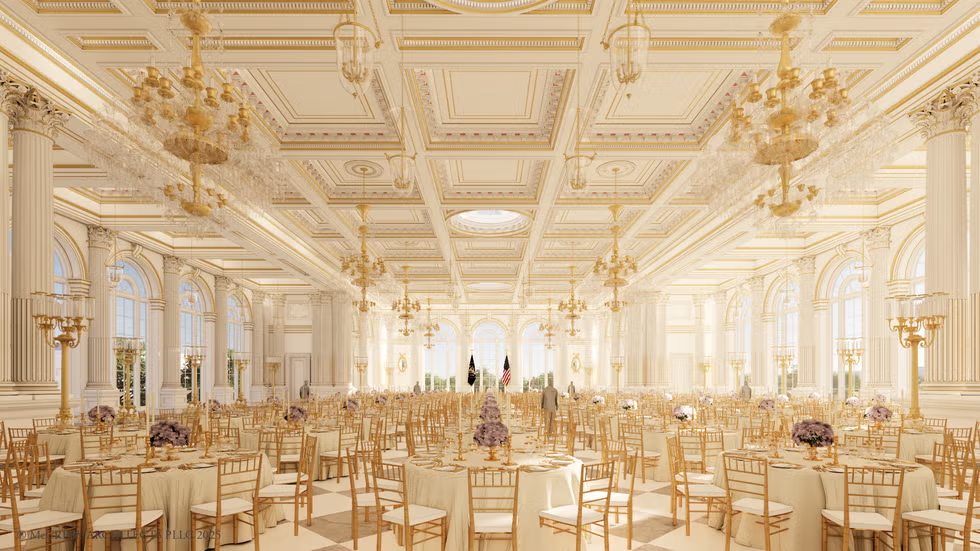
ELABORATE EXCESS: Trump’s gold-filled ballroom is realistically
rendered in a proposal released to the public.
Photo courtesy of McCrey Architects
Historically, major renovations to the White House have been rare. Whether it be Chester Arthur’s Victorian makeover, Theodore Roosevelt’s modern remodel, or Jacqueline Kennedy’s careful restoration, each alteration has marked a distinct and deliberate shift in the White House’s presentation. However, the scale and consequence of these changes pale in comparison to the $200 million East Wing Ballroom proposed by President Donald Trump.
The plan, formally announced in July 2025, calls for a structure of roughly 90,000 square feet with a seating capacity of 650 guests.This is more than triple the 200 person capacity of the East Room.
Previously the home of the First Lady’s office and support staff, the East Wing was demolished in October 2025 to make way for the ballroom. Since July, projected costs have ballooned to nearly $400 million, with funding expected to come from the president himself and a group of wealthy donors.
Valued for its symbolic importance and architectural consistency, the White House serves as an established vessel of American history. From the charred remnants left from British attacks during the War of 1812 to the original neoclassical design of James Hoban, its details house the stories of our nation that the proposal risks erasing.
Additionally, finances are a concern. At a moment when resources are stretched thin across foreign conflicts and domestic fighting, a $400 million endeavor for aesthetics demands justification. Parvathi Balakrishnan ’28 states plainly, “I think that our federal spending should be focused elsewhere, [such as] the current war and foreign relations. Instead we’re focused on this.”
Beyond monetary matters, the design itself differs strongly from longstanding architectural standards of the monument’s design. Episcopal’s own architectural expert and history teacher, Dr. Topher Row, provides a more detailed depiction of these blueprints’ implications. “This has nothing to do with political parties and nothing to do with who is in office,” he explains. “It has to do with architectural principles, volumetric scale, and what is and is not appropriate neoclassical architecture.”
Traditionally, neoclassical architecture centers on a dominant central pavilion, with secondary structures playing a subordinate role. “If this is built,” he explains, “then instead of being drawn to the center, one’s eye will be drawn out to the right.” He further criticizes the proposed decastyle portico, noting that “The Supreme Court is octostyle. The Capitol is octostyle. There’s no precedent for a decastyle cortico. It’s laughably architecturally illiterate.” Ultimately, Row summarizes his position in four words: “It is an abomination.”
Student responses to the proposal echo a broader tension between what is spectacle and what is necessity. Jack Signor ’26, student leader of the Young Republicans, plainly states, “I don’t care about a ballroom, there’s other problems in the world.” Signor’s frustration points to a deeper concern: in the midst of conflict in Iran, congressional sexual misconduct accusations, and relentless debate over domestic security laws, how much of our collective attention is being funneled toward an interior design project? Do aesthetics really matter more than lives and livelihoods? “I see people come to my priest with issues of housing and poor living conditions every week,” Signor reveals. “The President is comparing himself to Jesus. Yet we’re focused on ballrooms.”
Similarly voicing concerns beyond questionable architecture or aesthetics, Charlie Casey ’27 pulls straight from his AP World textbook in his criticisms. “To use a grim analogy,” he says, “the ballroom reminds me of the extensive renovations made to Versailles in the years preceding the French Revolution. It symbolizes a breach of the upper class into an area that should be strictly political.” Casey’s comparison presents an uncomfortable parallel to King Louis XIV’s absolute monarchy, referencing Versailles as a monument that consolidated power through beauty. He concludes, “I think it is a gross, egotistical waste of the United States budget. I think that it’s unnecessary, and it’s destroying valuable histories.”
As of now, the proposal has not gone unchallenged. The National Trust for Historic Preservation filed a lawsuit against the project last year, citing violations of the Administrative Procedure Act. The case was rooted in the belief that the president was attempting a severe overreach of his control over the White House. As Dr. Row explains, “You have one man wanting to impose his will on a building that he is a renter of, not the owner.” U.S District Judge Richard Leon halted construction in March, but the Court of Appeals for the D.C. Circuit has since paused the order through April 17.
Current debates between the administration and the federal court are expected to continue, and what happens after April 17 remains to be seen. What is already clear, however, is that the debate sparked by this construction regarding money, history, and the extent of the president’s control is far from over.