
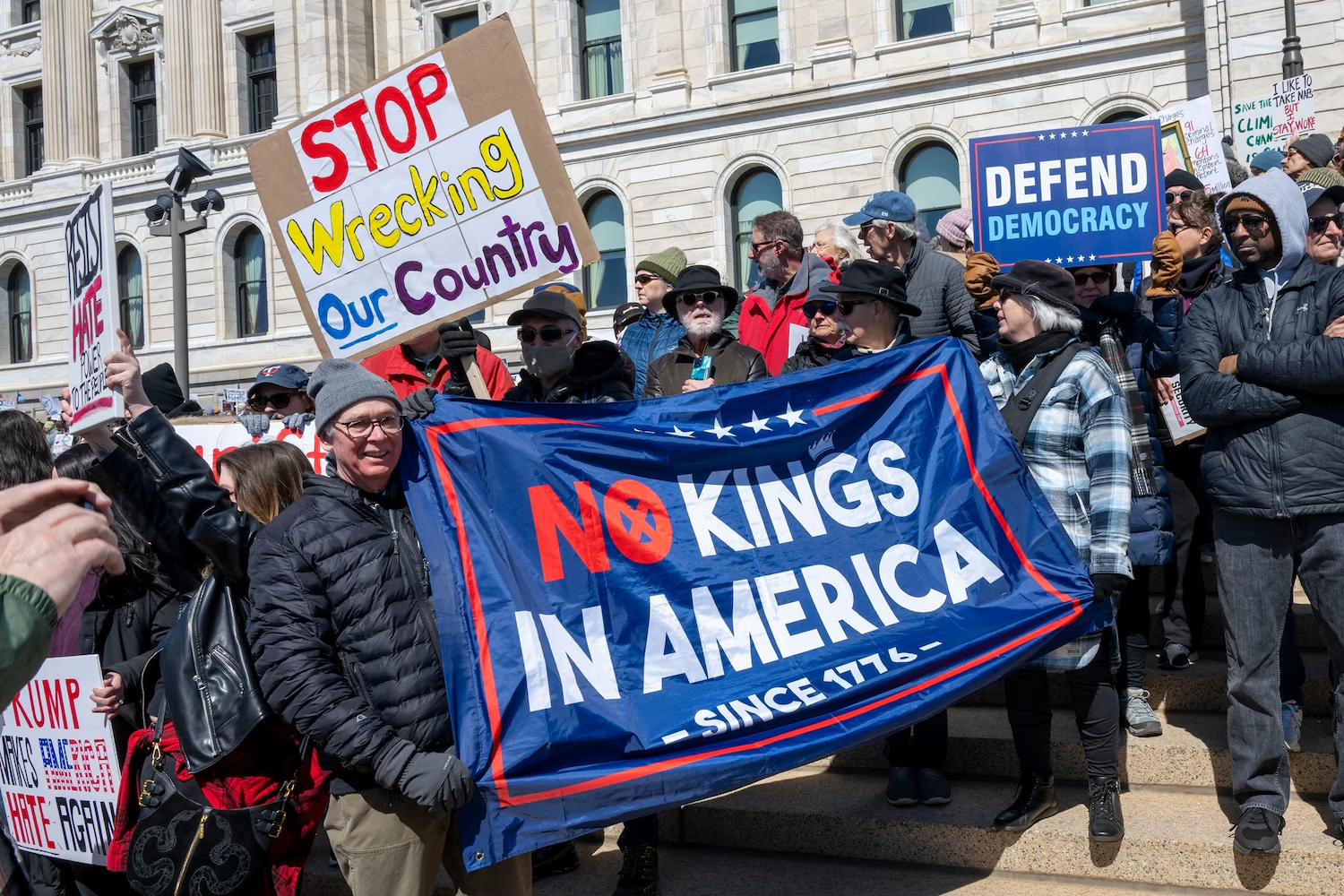
POPULAR PROTEST: No Kings protests rolled across the nation.
Photo courtesy of ABC News
On March 28, eight million Americans took to the streets across more than 3,300 sites, from downtown Philadelphia to Driggs, Idaho, to join the third “No Kings” protest—a nationwide collection of demonstrations protesting U.S. military escalation and domestic policy. Organizers called it one of the largest single-day demonstrations in U.S. history. Weeks earlier, high schoolers in California, Texas, and Maryland walked out of class over federal immigration enforcement. Across the nation, similar demonstrations and movements have only grown in fervor and number in recent months. At Episcopal Academy, they are nowhere to be found.
The No Kings movement, as part of a broader surge in nationwide activism, has escalated with each wave since June 2025, when roughly five million marched in over 2,100 locations across the U.S. By October, that number reached seven million. The March protest drew nearly nine million across all 50 states, with causes ranging from the war in Iran to what organizers call “democratic backsliding.”
Despite the broad range of concerns expressed at the No Kings protests, significant omissions—such as the Israeli-Palestinian conflict—have inspired many youth organizations and students to create their own demonstrations. For instance, on January 20, thousands of high school and college students in more than 900 locations walked out of their classes as part of the Free America Walkout. In California, students from over 30 schools formed the California Youth Unite coalition and staged coordinated walkouts under the slogan “ICE Out.” In Evanston, Illinois, around 100 high school students walked out to protest the war in Iran. The consequences of participation have been uneven and, in some cases, severe. In Quakertown, Pennsylvania, prosecutors reviewed footage of a police chief appearing to put a 15-year-old in a chokehold during a school walkout. Additionally, in Los Angeles, Tucker Collins, an 18-year-old USC freshman, lost an eye after being struck by a crowd-control projectile while photographing the No Kings protest.
At EA, political engagement takes a quieter form. The school hosts Young Democrats, Young Republicans, and Young Independents, but broader student involvement in activism appears limited.
Michael Whalen ’08, Young Republicans faculty advisor, drew a line between activism and civic duty. “I don’t think it is important for EA or anyone to be involved in political activism, but I do think it is important for all people to bear the responsibility of citizenship,” he says. “Part of this involves following the news and engaging in political discourse. In order to do so, people need to be able to think deeply about topics and challenge their own beliefs. That is one of the reasons that the humanities are so important for a well-rounded education.” Other students at EA share Whalen’s views. “Students don’t need to involve themselves in protests to be active,” says George Hampel ’29.
Other students stress the importance of civility in political demonstrations. Max Leung ’28 details his thoughts concerning protest etiquette, saying, “I think protesting is fine as long as you’re educated on the issue and you’re nonviolent.” He continues, “You need to be able to identify what’s moral from what’s immoral, but you also have to empathize with the other side rather than alienating them.” On whether protesting is part of EA’s culture, he was blunt: “I don’t think protesting is that large of a thing within the EA student body, honestly.”
Daniel Adibi ’26 put it differently. “The right of students to protest is something ingrained in our country, as stated in the First Amendment,” he says. “Students should be free to form their own opinions and petition their schools and governments based on these beliefs.” For Benjamin Heo ’28, he sees intrinsic value in the act of protesting itself: “I think it is good that people and students at such a young age can express their opinions. It highlights gaps and flaws in social or educational systems that need reform.”
Still, eight million people marched on March 28. Students elsewhere walked out of school and faced arrest, suspension, and injury. At EA, clubs meet and conversations happen, but as a student body, we remain largely silent. What that distance means, whether it reflects a different kind of civic action or simply a different set of priorities, is a question the student body has yet to answer for itself.