

Photo courtesy of NBC News
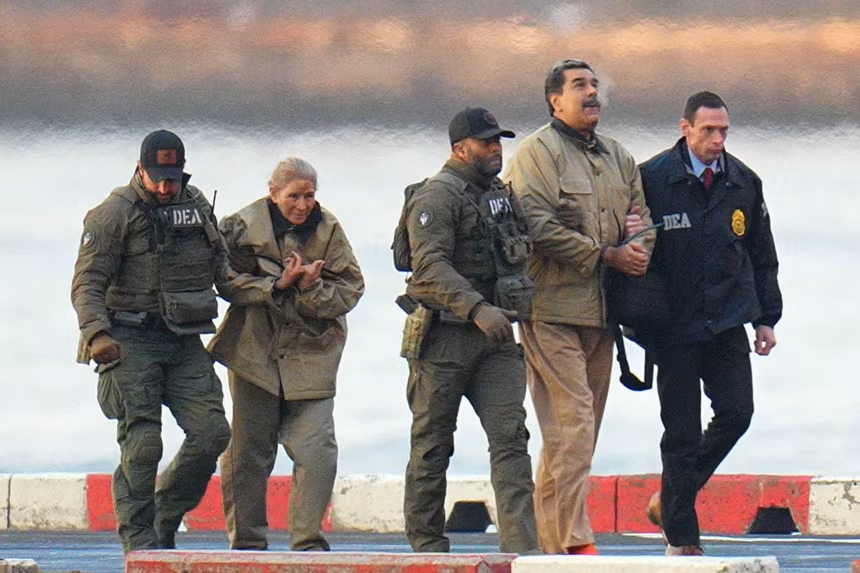
On January 3, the United States launched the military operation “Absolute Resolve” to remove Venezuela’s president and first lady, Nicolás Maduro and Cilia Flores, from the country.
Upon the mission’s success, Maduro and Flores were brought into U.S. custody, transported to New York, and arraigned on felony charges including possession of machine guns, narcoterrorism, and cocaine importation conspiracy—to all of which the duo has pleaded not guilty. The unprecedented attack by President Trump and his team has sparked bitter partisan debate as controversies erupt over the morality and legality of the operation.
The event culminates years of rising tensions between the U.S. and Maduro’s regime, which has been marked by an economic downturn, brutal crackdowns on dissent, and the rigging of elections. Maduro has been accused, by multiple international bodies such as the International Criminal Court (ICC) and the United Nations (UN), of violating basic human rights, and potentially committing crimes against humanity.
Between 2013 and 2025, thousands of Venezuelans have had their resistance to the regime stifled, with many being forced to flee the country and many others mysteriously disappearing. Beyond that, under Maduro, Venezuela has experienced an extreme economic decline, with the country’s GDP decreasing by 70% since 2014.
The two and a half hour mission, which led to the deaths of an estimated 130 Cuban and Venezuelan personnel but no U.S. casualties, was executed after weeks of long term monitoring of Maduro’s location. In an interview with the New York Post following the attack, Trump said that the U.S. debuted a new secret weapon called “The Discombulator,” which made Venezuelan military equipment “not work,” before adding that he wasn’t “allowed to talk about it.”
Charlie Casey ’27 remarks on the strategic aspects of the event, stating, “Although he didn’t have congressional approval, he was able to act faster than he would have been able to otherwise, and lives were certainly saved because of it. And in terms of the actual raid, it was nearly flawless: minimal loss of life, rapidly complete, and it was overall the fruits of investing so heavily in our defense budget, despite the issues that that’s raised.”
In the aftermath of the attack, Venezuelan Vice-President Delcy Rodríguez, a former diplomat and lawyer, assumed the office of President. Purportedly, her authority stems from a Venezuelan Supreme Court Decision ordering her to take the role, but it is widely understood that she was also backed by the U.S. government.
Upon her ascension, Rodríguez issued a defiant statement supporting Maduro as the country’s legitimate ruler, but has since seemed open towards allowing increased U.S. control over the country. U.S. Secretary of State Marco Rubio even testified to Congress that the U.S. will review the Venezuelan budget every month, and Trump has met with top oil executives in a push to get them to begin oil extractions in the country. The U.S. has extracted roughly 284,000 barrels to start, with plans to take 30 to 50 million in total.
These actions raise numerous questions about the role the U.S. can play in international affairs, and how these actions can influence the country’s global standing. According to the UN Charter, article 2(4), “All Members shall refrain in their international relations from the threat or use of force against the territorial integrity or political independence of any State, or in any other manner inconsistent with the Purposes of the United Nations.” By inserting themselves into the government of Venezuela, through military force, the U.S. government has violated the article.
Tracey Motley, Upper School math teacher, discusses this violation, sharing: “I do not understand how the U.S. feels they are in a position to go in and take over someone else’s government. I am challenged by that, and I am not sure what part of our constitution supports that. I’m very uncomfortable with the notion that we can take over someone else’s country.”
Motley also discusses some of Trump’s reasoning, adding, “I know that the current administration feels like by capturing the person they feel is largely responsible for the influx of drugs into our country [they can stop the flow, but] I don’t think the capturing of one person is going to change that.”
Another point of criticism is the intentions behind the attack. Rather than framing it in the context of disposing of an illegitimate ruler, Trump has appeared to paint the move as an opportunity for the U.S. military to advance the country’s economic interests.

Photo courtesy of The New York Times
“It would be best if [the goal] was to help the people of Venezuela, but I feel like that’s not very realistic about why [Trump] actually did it,” says Isabel Ding ’27. “I think there are more economic reasons, and also, I think our president wants to make a name for himself. By doing drastic actions like this, he gets more press coverage and to cement himself in history.”
However, other EA students feel that the attack, though perhaps against international law, was justified to stop the threat of drugs. “With the drug trafficking that has been going on in the U.S., we have a right to defend ourselves and stop this illegal import,” says Logan Bradica ’28.
Responding to criticisms over the attack’s violations of international law, Bradica adds, “International law doesn’t really mean much. You can only enforce it to a certain point and it isn’t exactly able to be enforced when you have the world’s strongest country.” Bradica continues, “People do this type of stuff all the time, and it violates international law, but nobody does anything about it.”
On a different note, Casey shares his thoughts, saying, “This action has a lot of merit, and I think even President Trump’s most vocal critics agree on that, but it severely erodes the idea of national sovereignty. The U.S. not declaring war on Venezuela, and acting out in an attack such as this one, does potentially open the door, or makes it more globally acceptable, for something like China to attack Taiwan, or Russia attack Ukraine, and have them justify it in similar ways.”
Similarly, Trump has repeatedly asserted his desire to gain control over Greenland, stating he wants “immediate negotiations” to acquire the territory. Trump cites national security as his reasoning, as Greenland’s location would provide early warning in the event of missile or naval attack. Trump has also expressed his concern for another global entity taking the territory, arguing, “If we don’t take Greenland, Russia or China will take Greenland, and I am not going to let that happen.”
Trump’s reasoning however, does seem to ignore the fact that the U.S. and Denmark have a longstanding agreement to allow the U.S. to have military bases in the region. These bases, which the U.S. has not expended many resources on, could be used to defend against an invasion of the island, or a missile attack against the U.S., without need for complete U.S. control over Greenland.
In response to these open and hopeful expressions of conquest, Greenland has stood firmly against the U.S., with their coalition government releasing a statement noting that they would not give in to pressure under “any circumstance.”
During the Davos economic forum in Switzerland from January 19 to 23, the U.S. and Denmark did agree to a new deal over Greenland, which although the details are mostly still unknown, appears to change little from the 1951 Agreement Relating to the Defense of Greenland.
The renewed focus on Greenland seems to reflect the Trump administration’s push to revive the Monroe Doctrine, a foreign policy strategy adopted in 1823 that asserted U.S. hegemony over the Western Hemisphere and committed the country to not interfering in European affairs. Trump has named his version of the plan the “Donroe Doctrine.”
Trump’s musings about Greenland have faced significant backslash in the U.S., with members of Congress, the electorate and the EA community harboring reservations about the possible annexation. Motley elaborates on these sentiments, sharing, “I am beyond perplexed as to why we are trying to acquire Greenland. I think it’s overreaching, and that we need to stay in our lane.”
Yousuf Gilani ’28, comments on Trump’s desire for Greenland, saying, “We’ve kind of relapsed into these power politics where it’s like, ‘I’m stronger than you, [I can do whatever I want].’” Gilani then mentions how the U.S. only accumulated this power through its cooperation with the rest of the world and commitment to UN initiatives.
Gilani also touches on some other reasons for the U.S. not to take Greenland, explaining, “I don’t even know if I think Greenland should be a part of Denmark because they have such a unique culture. I was reading yesterday about the history of Greenland, and it’s a majority [Greenlandic] Inuit country. If the U.S. purchases them, that’d be kind of putting a price on sovereignty, saying that they don’t have that right, and saying that it’s only really Denmark’s right.”
As a whole, the U.S. military’s actions in Venezuela have proven to be highly controversial, and only time will tell how the aftermath of Maduro’s capture will unfold. In parallel, it will be interesting to see how Trump’s claims to Greenland are resolved, as well as how the world stage reacts to the U.S’s recent conduct and aspirations.