Kyle Zhang ’27

Photo courtesy of Kyle Zhang ’27
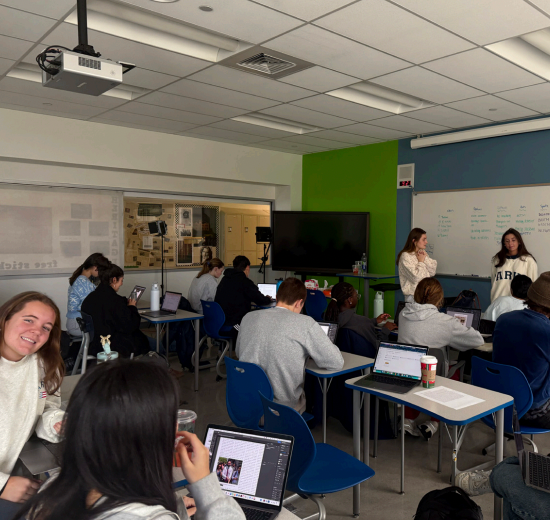
The wide variety of student-led clubs at EA serves as a reminder of some of the core values of the student body: passion and leadership. Whether it’s community service, a space for students to bond over shared interests, or a publication like this very newspaper, there is a club for every student at EA. However, while these extracurriculars are an integral part of the community on paper, some students raise concerns that some groups meet very infrequently or not at all, stunting their potential positive impact on the EA community.
Certain clubs at EA appear to only exist on the online club webpage. “I’m not going to name any names,” starts Will Patterson ’27, “but some of the clubs I’ve signed up for haven’t even sent out their first email yet. I think a little more than half of the clubs I signed up for at the fair have had a meeting this year.” Many other students echo this sentiment. “I can think of one or two clubs that I was really excited to participate in that haven’t met this year at all,” agrees Diya Methi ’27. So, why do some clubs fail to meet?
To understand this issue, it is important to first understand how clubs are established. “[Student council] gives [students] an opportunity to apply for a club. There’s a form on the EA Upper Google site, and as long as you’ve met the requirements, you get a trial run for your first year,” explains Lorie Harding, one of the faculty advisors for the Student Council. “If any club is community service-based, we’d have the students go talk to Father Gavin or Madame Brotschul… They have to ensure that they have members; it can’t be a one-person student-led club.” Creating a club requires detailed planning, a skill that should translate over to consistent meetings and community impact. However, this doesn’t seem to be the case for some clubs.
One reason for the inconsistency in Upper School club meetings is logistics. For some clubs, it may just be challenging to organize meetings. Personally, my club, the Pathfinders Club, requires off-campus meetings to participate in volunteer work. This means setting up transportation, coordinating with faculty to ensure the meeting is appropriately chaperoned, and signing waivers for volunteers. Clubs with a higher barrier of entry require more work to set up events, deterring busy student leaders from investing their time into organization and management when they could be focusing on schoolwork or other extracurricular activities.
An alternative solution is to simplify meetings by keeping them on campus to maintain interest. Info sessions or quick gatherings to discuss topics explored by the club can complement or even replace larger, off-campus events and sustain enthusiasm. A club can also be centered around a single event for a more concentrated timeline and impact on the community, provided this approach is communicated with student council: “Some clubs will explain that, ‘oh, we’ll just have one big meeting in the fall where we’ll go off campus…’ and if they can explain why, then it makes sense, and we can understand that,” says Charlotte Franklin ’26, president of Student Council.
For more support, student council is always available to provide necessary guidance to any struggling clubs. “In the middle of the year, we meet with each new club, and we ask them how their meetings have been going, how many times they’ve met, and how many people have shown up for their meetings. Depending on their answers, we might say, ‘Okay, you guys should take another pilot year to figure this out a little better,’” Franklin explains. To effectively run their club, student leaders should take advantage of the guidance that the student council has to offer.
However, while some clubs don’t run as frequently, it is essential to consider the impact created by the wide range of student-led groups at EA. With the help of various faculty members, publications such as the Scholium and the Epolitan enrich our school’s culture and bring its students together. Community service clubs offer opportunities for giving back to the broader community.
Overall, EA wouldn’t be the same without these groups, and their presence is indicative of the vibrant, well-rounded community at EA. “We do have a lot of clubs, which is interesting that there’s so many students passionate about so many different things. And so you can find that to be a very good thing about the school and about the student body here,” concludes Harding. While increasing club meeting frequencies in the Upper School is something to work towards, the club scene at EA already does enough for the school. Stressing unnecessarily over the sheer quantity of club meetings distracts from a club’s core purpose: adding to the community.