Daniel Adibi ’26

Photo courtesy of Matthew Memmo
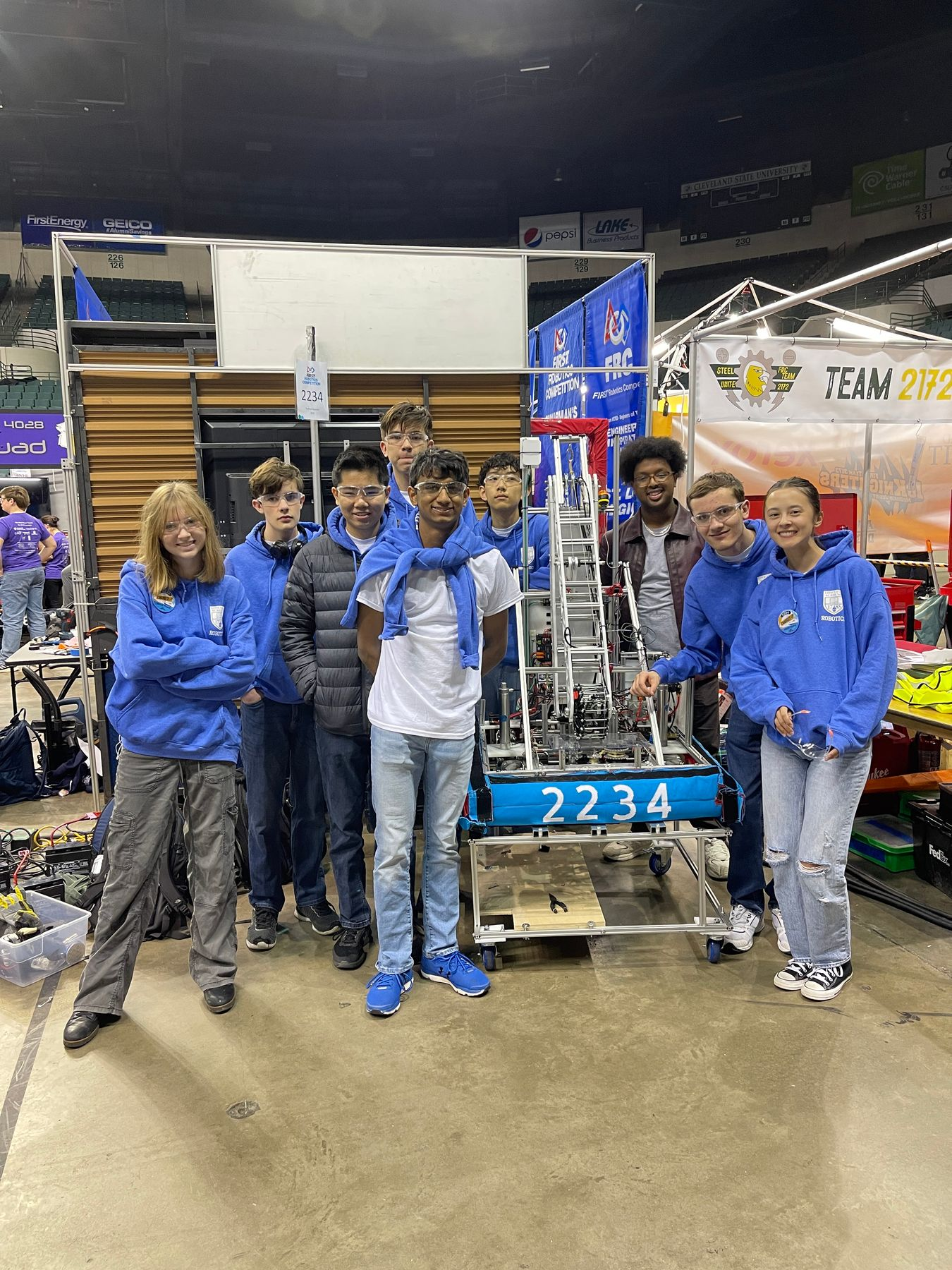
During the winter, EA’s robotics teams are busy at work constructing 120-pound robots to compete in the FIRST Robotics Competition (FRC). The competition and EA’s involvement provide an opportunity for students passionate about STEM to explore engineering hands-on. Yet, behind the excitement of the season, a deeper question lies: who is funding the innovation taking place at FRC?
FRC itself is sponsored by defense contractors such as BAE Systems and Raytheon Technologies. This has sparked concern for some who worry that this could send a harmful message to kids: their interest in STEM should inevitably align with military or defense applications. Additionally, many teams in the competitions are sponsored by large corporations such as NASA, Lockheed Martin, and Boeing, giving some an unfair advantage. Ultimately, for many, the concern lies not in the ethical concerns of defense contractor sponsorship, but corporate sponsorship of individual teams.
On the one hand, while defense contractors’ sponsorship of FRC can portray a limited application of students’ interest in STEM, the broad spectrum of defense companies’ operations and promotion of cooperation within FRC largely dismisses this concern. Upper School Science Teacher Ted Mathisen, who serves as a faculty mentor for EA Robotics, comments on the large range of initiatives covered by defense contractors beyond weaponry: “Most of the interactions between a sponsor and the robotics program… tend to focus on non-militarized elements. We’re talking about search and rescue type of operations, focusing on infrastructure projects.”
Furthermore, the sponsorship of defense contractors can actually be beneficial to FRC participants by exposing them to real-world applications of robotics. EA Robotics engineer Mason Jiang ’26 explains, “Having real corporations that utilize robotics… makes [students’] work feel more tangible and applicable to the real world. These defense contractors aren’t trying to spread messages of war but trying to nurture young minds and help them see how tech is being used in the real world.”
To this point, FRC emphasizes healthy collaboration between teams by helping to incentivize cooperation with additional points in competition. As a result, the possibility of defense contractors promoting violence through the competition is largely overstated. As Mathisen says, “A lot of people, when they think robotics, [are] thinking battle bots and things like that—which can be a lot of fun, I’m sure—but that’s not the type of competition we’re participating in anyway. The competitions we’re doing are really more challenge and coordination oriented than they are combat oriented.” Echoing this point, Lawson Cale ’26, a member of the robotics team, explains, “The robotics competition is a very peaceful activity—there’s a lot of cooperation involved in the matches.”
A much larger issue central to the First Robotics Competition is corporate sponsorship of individual teams. However, this type of sponsorship does have its benefits. For many teams, corporate funding is essential to their ability to even participate in FRC. As a faculty mentor for EA Robotics, Christy Rheam points out, “It’s very expensive to build these robots. The robots themselves, going to the competition, cost several thousand dollars, so it’s not a cheap thing to be involved with.” Cale adds, “The barrier of entry to robotics is pretty high. I had a friend who wanted to start a robotics team in his high school, and he literally had to sit outside the front door selling lollipops to people as they left to raise money. So it’s a very, very expensive thing to get into for any team. So I think sponsorships are a great way of lowering that barrier of entry.”
This mentor-based and excessive resource-based backing is ultimately the greatest issue with FRC sponsorship. At competitions, it can feel demoralizing for team members to see other robots with custom-made parts, making the competition feel slightly pay-to-win. Jiang comments, “I think that companies should be able to sponsor teams. But they shouldn’t be able to completely manufacture any sort of part for the robot…they can’t actually build stuff for the teams, or else it produces an unfair advantage. [FRC] is supposed to be a competition for high school students, not professional engineers.”
Ultimately, FRC sponsorship is a topic of controversy for participants. While defense contractor sponsorship for the competition does not present an issue for many, corporate sponsorship for teams leads to unfair advantages and a reduction in student participation. However, considering the undeniable benefit sponsorship brings to under-resourced teams, banning sponsorship is not feasible to preserve the mission of the competition to encourage hands-on, collaborative, and fun engineering engagement. What FIRST needs to do is to cap teams’ budgets and the resources robots are allowed to use.
However, even with the current situation, robotics team members continue to enjoy participating in the competition. For most, participation is about the experience, not necessarily about gaining recognition. As Mathisen explains, “It is how it is, and I don’t think it’s going to change anytime soon. [FRC] could encourage a somewhat more fair balance of distribution. But the way it is, works—I get to still have fun.”