Danity Pike ’27
Kyle Zhang ’27

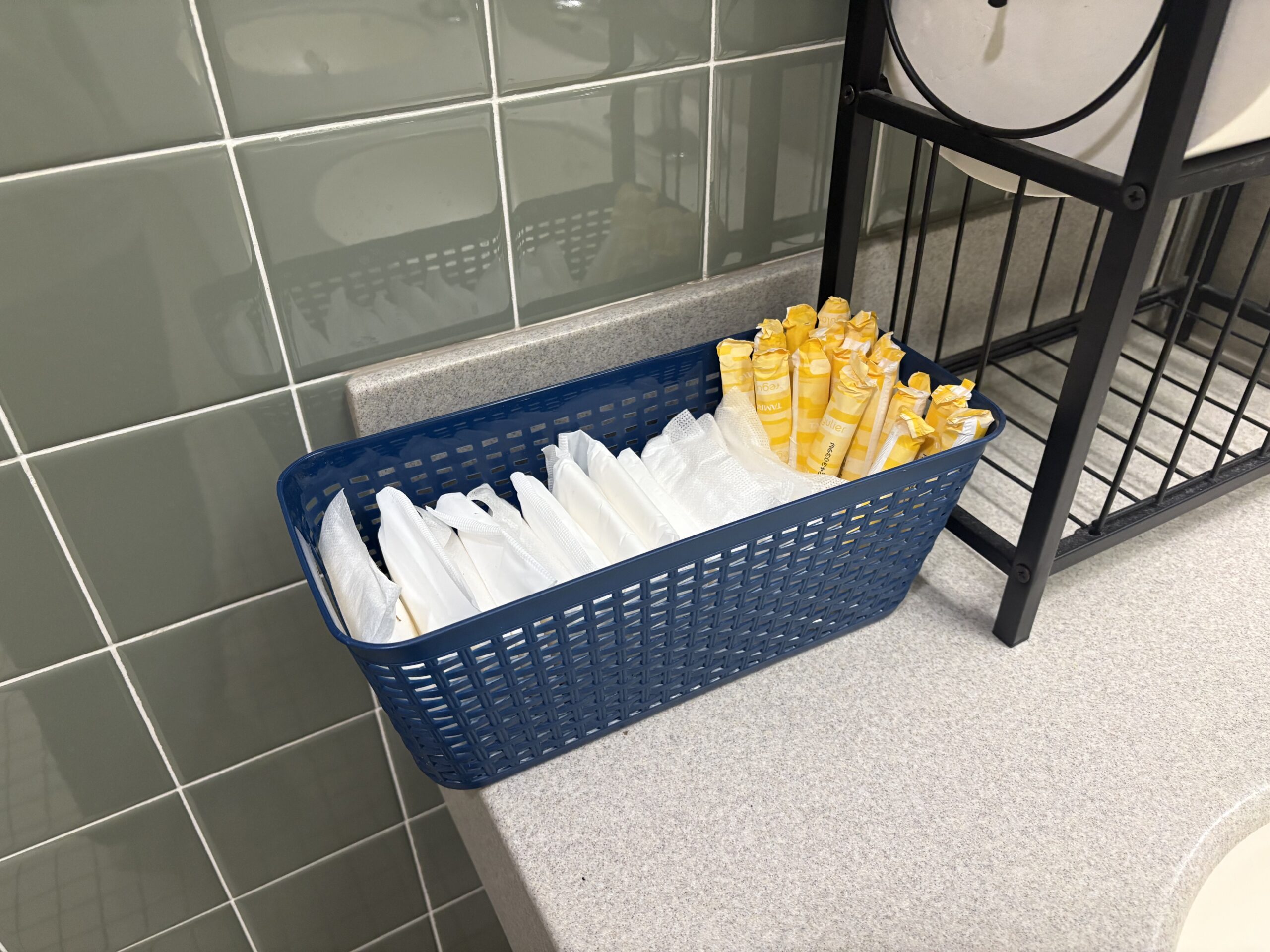
1st floor US Girls Bathroom.
Photo courtesy of Mahika Ralhan ’26
All female-identifying students were recently gathered in the Chapel for an announcement. Ms. Erica Snowden, Executive Director of the Office of Diversity, Equity, and Inclusion (DEI), explained the Student Council’s initiative to add feminine hygiene products to certain bathrooms across campus. Students felt content with the new reliable accessibility to period products—but why weren’t period products already consistently available? How does this change set an example for other student-led initiatives?
During the pandemic, period products were supplied in female bathrooms, then subsequently removed due to misuse. Pads and tampons were flung onto ceilings, flushed down toilets, and excessively used in bulk amounts. “I can attest, once I went to the campus center and there were wet tampons on the ceiling,” says Andrea Yu, US Librarian and a faculty advisor for Student Council. Snowden comments, “I think some of that [misuse] is around learning and experience, and having conversations rather than removing it, because removing it doesn’t mean that we no longer need it.” This year, leaders in the Student Council began addressing the absence of these resources, first through Snowden’s office, by inquiring why bathroom baskets were empty of feminine hygiene products.
As the facilitator of Student Council DEI members, Snowden emphasizes how this issue relates to DEI at Episcopal: “When you think about equity and everybody having what they need, one might say that girls who menstruate don’t always have what they need here. I think that as a school who prioritizes mind, body and spirit… this is something that we can do that feels like an easy fix.” This implementation greatly improved accessibility for female students by removing these barriers to success. To walk across campus for a pad or tampon would be a great inconvenience, especially during valuable class time. Ellie Rheam ’27 notes, “In a situation where you don’t have something, and you’re caught unaware… it [a period product] is definitely a helpful thing to have.” Though pads and tampons have only been supplied in selective bathrooms in the Campus Center and Upper School, Snowden is hopeful to expand to all corners of campus.
Impressively, Student Council members spearheaded this initiative, demonstrating how change can begin with student observation and end with real, systemic achievement. Ryann Newcomb ’26, Class of 2026 DEI Member, describes, “We had all heard our female peers voice concerns about the lack of female products in bathrooms, and we drew the conclusion that this was an issue of equity, because these products are in absolute necessity to our environment.” Newcomb further details how the DEI representatives drafted an email and met with administration to successfully pass the initiative.
Ryan Klein, Upper School V Form Dean, states: “Typically, the deans meet with Mr. Letts 3 times a cycle. So, if something comes across one of our desks in those meetings, we usually bring up, ‘Hey, one of my students came by and started talking about their thoughts,’ and we have an open forum to discuss what we feel is the best consensus to address the issue.” The student voice can serve as a catalyst for change only if the appropriate faculty members are made aware.
For example, the reintroduction of Aurora Vesper Day was driven entirely by the student council. The long process of overcoming administrative hurdles to incite change can only be driven forward by conversation: “They kept asking for it [Aurora Vesper Day] and asking for it… and now we’re going into year three of doing it,” Yu remarks. Persistence is key to ensure administrators understand what the students want.
Looking broadly at the current landscape of EA’s community, Yu and Klein do not note any major initiatives taking place. However, the reimplementation of feminine hygiene products serves as a powerful example for what is possible. In the future, should any issues arise in the community, it is up to the students to advocate for themselves and lobby for change. “Your opinions matter and your ideas are worth talking about. I hope the Student Council can be a vehicle for that,” explains Yu. Students dissatisfied with the circumstances in their community must speak up and utilize the pathways available at EA to make themselves heard. Snowden concludes, “Although this may seem like a girl issue, I think it’s just a human issue.” All students should rally to address these human issues. The new addition of feminine hygiene products back in bathrooms is not only a vital step for equity at Episcopal, but also a reflection on what makes EA’s community so great: the united, capable student body.