Vivian Cook ’27
Following the return of students from winter break, EA installed LanSchool, a classroom management software designed to empower educators to engage and communicate with classes, on all Upper School students’ school-issued computers.
Although the software has many features, its primary use is for teachers to monitor students’ screens and ensure that they are both on-task and avoiding the use of artificial intelligence during class. The software works from the hours of 8 AM to 3 PM, and only functions when the laptops are on campus, connected to EA Wifi. This major decision has proven to be controversial, leading to discussions regarding the ethics, sustainability, and benefits of the program.
LanSchool has been used in the Lower and Middle schools since 2024. In the lower grades, many teachers have found it to be extremely helpful in the classrooms, especially because the students are younger. Heather Dupont, English Department Chair, shares some specifics about the benefits of LanSchool. “It’s really been great for transition time,” she says.“Teachers are saving five to fifteen minutes each class. Teachers can really watch and help. I think the biggest things are the transition times, the easy projection, the pushing websites, and certainly helping kids manage their time and stay on task.”

ing class.
Photo courtesy of Will Newman
However, as Upper School students are older than lower and middle schoolers, have more responsibilities, and are entrusted to manage themselves more than younger students, debate has sparked over LanSchool’s implementation. While some believe it was necessary to combat issues with AI, others feel it is a sign of uncalled-for distrust.
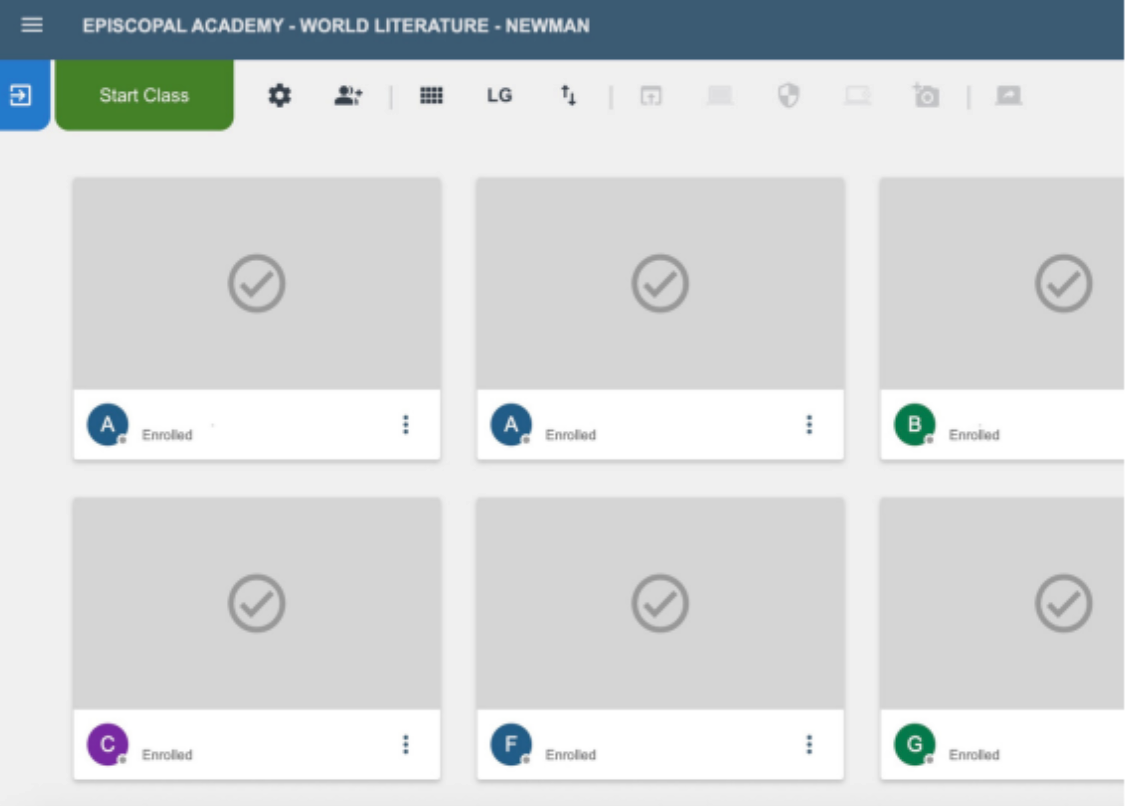
Although LanSchool has many different features, it is most known for giving teachers access to students’ screens once the laptop has been signed into that teacher’s class. Once a class has started, teachers can see all of their students’ screens, limit the websites students can log onto, and select a blank screen to appear on a laptop if a student is on a website they should not be. Additionally, teachers can control websites and activities of entire classes at once, ensuring that everyone is on the same page and where they need to be.
Aside from the monitoring aspects of LanSchool, the extension is also helpful for communication purposes. The messaging feature allows for direct student-to-teacher communication, enabling individual support without class interruption.
Head of Upper School Michael Letts explains how both the screen monitoring and messaging features can be useful in instilling study habits into the high school’s younger students, sharing, “If a ninth grade student is in a study hall and is not working on their work when they should be, instead of going over and potentially embarrassing them in front of other students, [faculty can] send a chat.” By doing this, proponents stress that students can be redirected to their work and will begin building productivity skills that will help them throughout the rest of their time in high school. However, critics argue that by overly-controlling students’ actions, EA risks lessening their independence and allowing them to assume responsibility for their own decisions.
LanSchool’s primary purpose is to address and navigate the complex nature of AI usage in academic settings. While many different strategies have already been implemented at EA—namely, the transition to in-class essay writing, and the usage of Lockdown Browser and AI detectors—they all have drawbacks that LanSchool should be able to solve. For instance, these older strategies have frequently led to false accusations of AI usage, trouble with adding extended time to Lockdown assessments, and complaints regarding the textboxes within Canvas Lockdown. With LanSchool, students can work within applications, like Google Docs, for as long as they are permitted, and teachers can monitor everything in one place.
Departments across the school, especially English and History, have spent the last few years coming up with ways to mitigate the usage of AI in essay writing, and are mostly enthusiastic about the implementation of LanSchool.
Upper School English teacher Tony Herman touches upon the effects AI has had on both student writing and critical thinking, articulating, “The problem is that the more students rely on other things to do their work, the less they rely on themselves, and thus their intellectual gains and capacities will lessen, and their critical thinking will [too].” History Department Chair Steven Schuh believes that although AI is a complicated issue, LanSchool can help ensure academic integrity, noting, “I don’t think there is a solution [to AI usage]. I think this is just another tool in the box to try and ensure academic integrity.”
Schuh also notes that each individual teacher is free to make their own decisions regarding the implementation of LanSchool, and that most probably don’t use it. “I would suspect that most [teachers] are certainly not using it all the time,” he explains. “But, you know, I think for in-class assessments that are done on a computer, most will probably use it.”
Students share privacy concerns over the software. “Trust is very important, especially the trust in student-teacher relationships. [LanSchool] feels like an invasion of privacy,” says Sam Slye ’27. Other students agree to an extent, sharing privacy concerns but also weighing that against potential benefits. Karthik Ramakrishnan ’27 shares, “It’s somewhat an invasion of privacy, but it keeps students on task and keeps them from doing things they shouldn’t be doing in school. [I struggle with] the communication aspect of having an email with a teacher or parent open, and another teacher possibly seeing it.”

computers has raised privacy concerns in the community.
Photo courtesy of Darian Mihalakis ’27
There is also some consensus among students that while the testing applications of LanSchool could be helpful, the monitoring of activities in class feels like a privacy invasion that violates student-teacher trust. “I think it’s beneficial because taking tests with Google Docs instead of Lockdown Browser definitely helps with all the lagging and technology issues,” says Anthony Romano ’27. “But one thing I don’t like is, for example, if I’m in my literature class and my math teacher from my last class is still monitoring my screen.” Romano adds that, “If a teacher is monitoring my screen while my mom texts me, and the teacher can see all of my recent text messages from my mom, [that’s] definitely an invasion of privacy.”
Overall, LanSchool promises to try to solve pressing issues revolving around AI plagiarism. Yet, until more time passes, it remains to be seen how successful the implementation will be.