Mia Favini ’27
The Episcopal Academy is renowned for its rigorous academic program, complemented by an abundance of extracurricular opportunities. EA does not center itself in one department or discipline. Instead, its wide range of programs makes it a special place. A student can participate in the theater program while also competing as a dedicated athlete, a balance that other schools often struggle to provide. Within its courses, EA offers a wide range of subjects, including Filmmaking and Honors Anatomy and Physiology. However, with this advantage comes a disadvantage. EA requires all students to complete a long list of graduation requirements. So, how much room is left for students to explore EA’s most distinctive courses? Can students balance the most challenging academic tracks while still opening themselves to electives that sparked their interest in the first place?
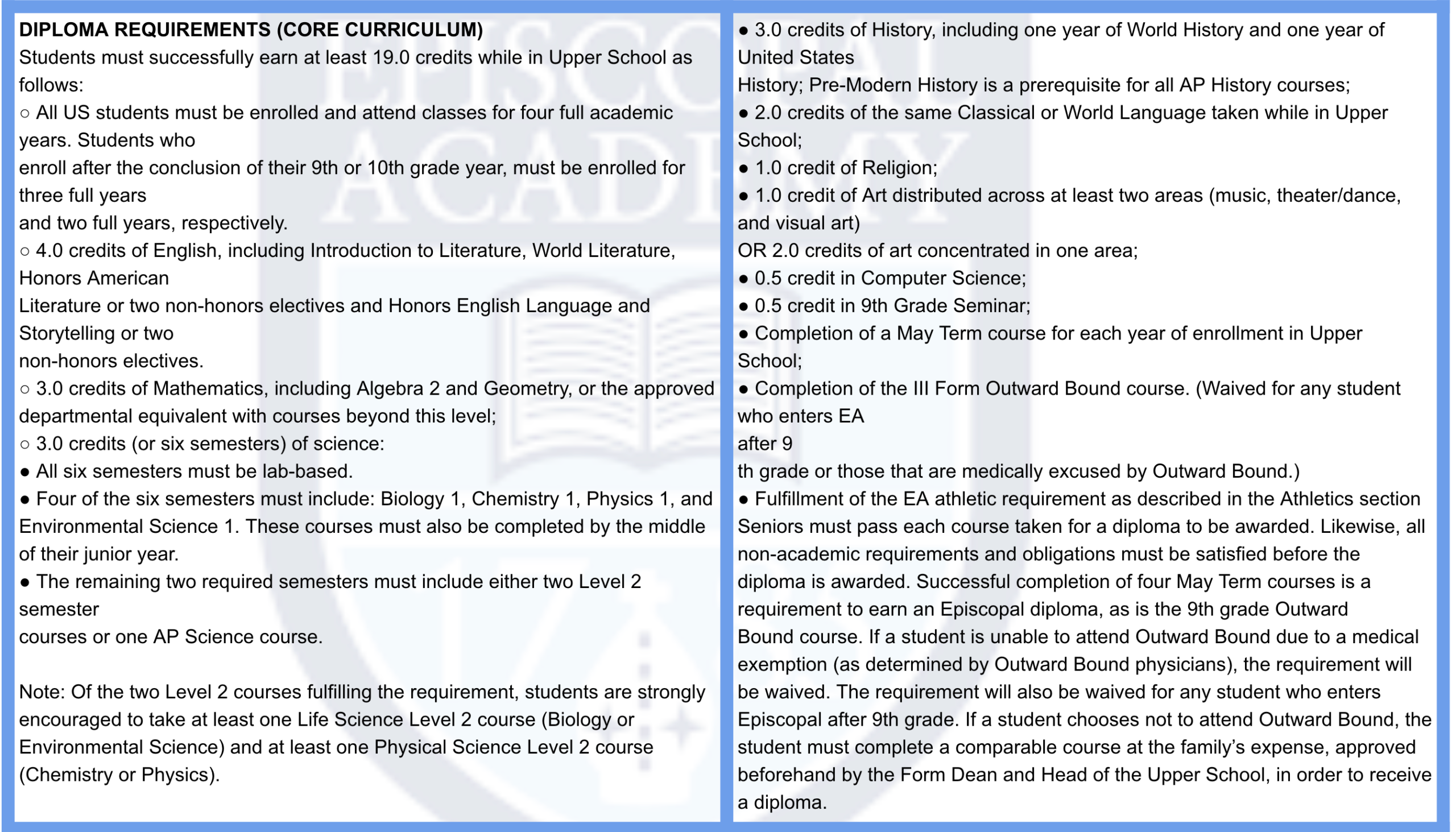
So, why does EA have so many requirements? Administration creates the schedule with the intention of maximizing student learning. However, students may feel that the graduation requirements confine them instead. The current schedule allows students to take a maximum of 7 classes, with only a singular free period to meet with teachers or catch up on homework. This also leaves little to no room for the rich arts program offered by EA beyond the credit requirement for students who may be interested. Administration makes a sincere effort to teach students essential skills without confining them to a single discipline. For example, the computer science department requires each student to take at least 0.5 credits. With new technology constantly advancing, understanding the basics of new innovations is a necessary skill. Similarly, religion serves a greater purpose than simply teaching students about a specific belief. Religion at EA teaches students not only about faith, but about morality, emphasizing how they can contribute to improving the lives of others in addition to their own.

Photo courtesy of Upper School Handbook
Additionally, Mike Letts, Head of Upper School, says: “High school is also a time when you’re figuring out who you are. You might take one of those classes and not like it, but you’ve learned something about yourself.” Instead of thinking of the requirements as a burden, Letts recommends that students “think of them as explorations into finding out who you are, what makes you tick, and where you want to start moving your focus and attention as you approach college and eventually a career.”
To what degree do students feel as if they have the flexibility to explore EA’s curriculum? Some students feel the requirements are a path for further exploring their interests. To explore this idea, Natalie Jiang ’27 added, “The system definitely encourages exploration, as students are required to take classes from multiple disciplines even as freshmen, and each department also goes very in-depth with its classes.” For Jiang, the requirements didn’t serve as a barrier but rather an opportunity to explore different disciplines. She said that if it weren’t for the requirements, she might not have taken an interest in subjects outside her comfort zone.
On the contrary, some students, like Isabel Ding ’27, believe EA’s graduation requirements, while designed with students’ best interests in mind, often limit their freedom to choose their own classes fully. As a result, many students end up taking courses that genuinely interest them only during their final years of high school. To demonstrate, Ding says, “I’ve actually had a lot of classes that I wanted to take but couldn’t because of my schedule. For example, I really wanted to take another semester of English along with Honors English, but didn’t do so because I was prioritizing STEM classes for college and my schedule was very full.” Due to Ding’s focus on college, she had to make sacrifices about which classes might interest her, versus which classes she would need to take.
EA’s graduation requirements can be what you make of them. They can provide opportunities for students who otherwise might have confined themselves to one discipline. Instead of just learning within certain departments, the requirements allow students to further explore their interests. However, they have also served as restrictions for others, as they limit course availability from the beginning of their high school careers. Per Letts’ words, the best way to approach course selection is to consider it a game: “I would prefer you approach the game from the perspective of what puts you in the best light is to fully develop who you are, what you really enjoy, and to really double down on using your high school experience to figure out what you love—how you want to contribute to this community, and then to a future college community. Explore the interests that you have and the passions.”
Maybe the key to balance at EA isn’t changing the rules of the game, but redefining how we play it, because at EA, the question isn’t just what classes we take but how we turn those choices into who we become.