

Photo courtesy of ABC News
This September, the United Nations held its eightieth General Assembly, an important annual diplomatic event where all UN member nations convened to discuss major diplomatic problems across the world.
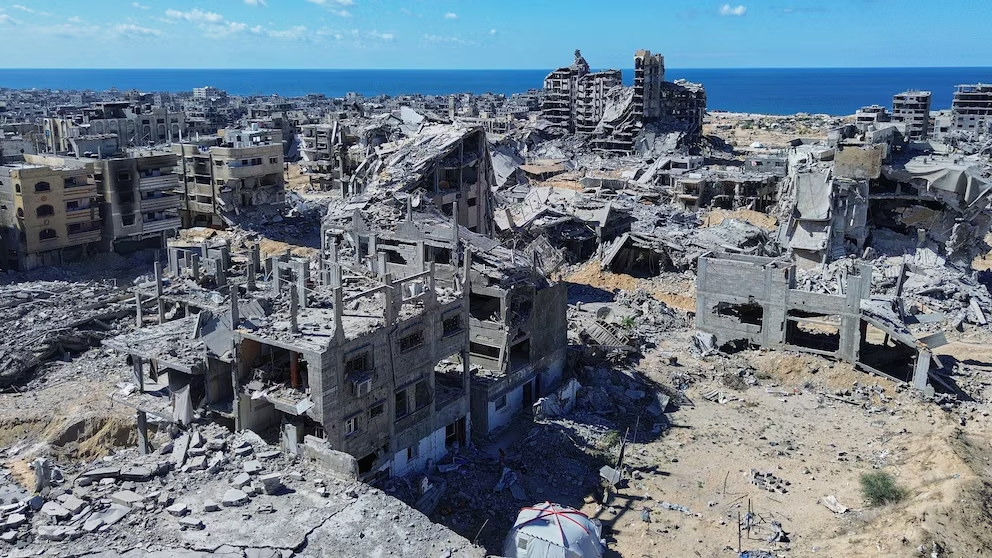
The focal point of the meeting was the war in Gaza, which has caused international outrage over the starvation, killing, and kidnapping of countless civilians. For Israel, the fight is deemed necessary to remove Hamas as a threat to their security, especially after the attacks they experienced on October 7, 2023 in which hundreds of innocent civilians were kidnapped. Even so, the mass of casualties for the Palestinians has caused a precipitous downfall in global support for Israel as millions across the globe decry what experts, legal scholars, and the UN itself call an Israeli-propagated genocide. In a sign of this shifting landscape, a recent New York Times poll revealed that for the first time, more Americans sympathized with Palestine than Israel.
Before and during the meeting, France, the United Kingdom, Canada, Australia, and other countries formally recognized Palestine in a major diplomatic win for Palestinian statehood. Additionally, ahead of a speech by politically besieged Israeli Prime Minister Benjamin Netanyahu, dozens of countries walked out of the assembly and hundreds of protesters gathered in Times Square. A defiant Netanyahu, whom the International Criminal Court has issued an arrest warrant for, spoke regardless, describing Palestinian recognition as a “mark of shame,” and calling the move a message that “murdering Jews pays off.”
The situation in Gaza is fast-moving; in mid-October, President Donald Trump was able to facilitate a ceasefire deal between Israel and Hamas. The deal involved the release of all remaining hostages by Hamas and an immediate cessation of the conflict. However, it is unclear how tenable the deal is. Israeli forces have killed at least 97 Palestinians since the start of the cease fire, and both sides have traded accusations of violating the terms of the deal. As recently as October 19, after a fatal explosion during demolition and recovery efforts in Rafah, Israel briefly resumed air strikes only for tensions to quickly cool again after the US’s urging
On a similar note, another major focus of the UN meeting was the role of the US in global politics, which has undergone a dramatic shift under Trump. During the assembly, the country attempted to reconcile its position as a global leader amid increasing domestic turbulence.
Over the past year, the US has stunned allies with large tariffs as part of Trump’s focus on boosting American manufacturing. The president has also cut millions of dollars in foreign aid and withdrawn from international initiatives such as the World Health Organization and the 2015 Paris Climate Accords. The moves, which reverse decades of previous policy, have caused significant consternation among countries around the globe.
At the UN, Trump delivered an address mainly focused on emphasizing the importance of America at the meeting, using it as a platform to spread the idea that “on the world stage America is respected again like it has never been respected before.” He also expressed his hope to end both the wars in Ukraine and in Gaza, which he was able to temporarily enable.
Commenting on America’s changing global position, Lorie Harding, The Anthony W. Ridgway Librarian’s Chair and Director of Libraries, comments, “I think as priorities change for nations, that’s somewhat normal to wax and wane based on various administrations, and so, I don’t know if it’s more indicative of a pendulum swing back and forth as some nations have other things that they have chosen to focus on, or if it is really an intentional change for the United States.”
Amidst this address and assertion of American dominance and success, Trump has been a vocal critic of the UN, questioning the efficacy and relevance of the organization. “What is the purpose of the United Nations?” he questioned at the September meeting. “All they seem to do is write a really strongly worded letter and then never follow that letter up.” He did, though, acknowledge that the UN has “tremendous potential.” Chair of the Religion Department Michael Sheehan ’04 disagrees with some of these criticisms, sharing, “I think we’re facing some really big global problems…and I’m not an expert on UN councils or [the UN’s] directives, but I think there’s something fundamentally important about unison in a time when action is required.”
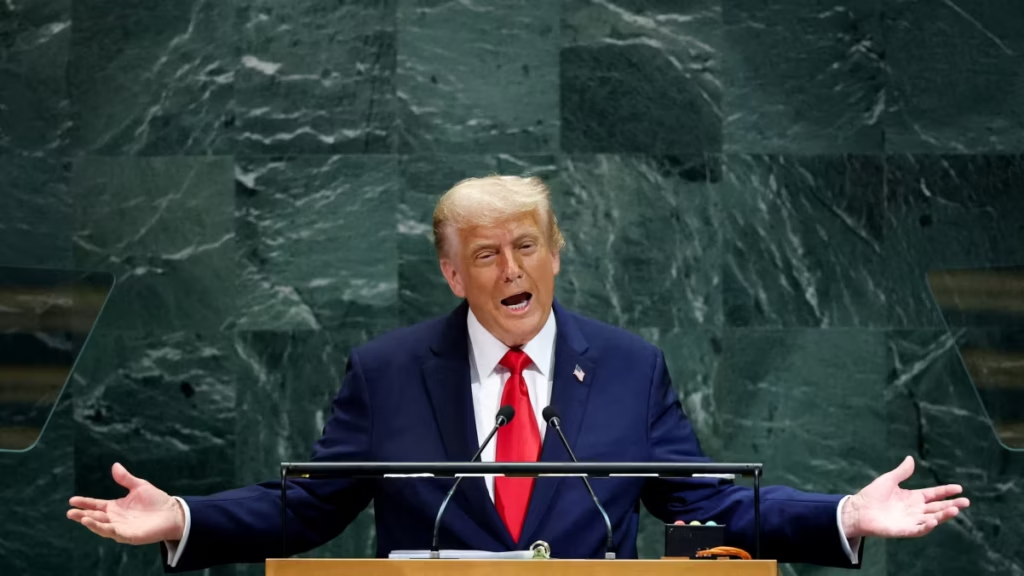
Photo courtesy of ABC News
In light of the US somewhat withdrawing from the affairs of the UN, China has shown an interest in filling gaps left by the US, particularly related to issues regarding climate change and the environment. As the U.S. turns away from renewable energies, China has redoubled investments. “I think environmental leadership is really, really key…We all share this planet, and the actions on one corner of it ripple and impact the actions and the standings on another side of the globe, so I think it’s important that…global powers have a responsibility to the planet,” Sheehan shares.
As China continues to assume greater roles of leadership throughout the world, first industrially and now politically, some have expressed concerns about America’s influence in the future. “I think America has seen a decline in more recent years, both in production and industry,” says Jack DeSilets ’27. “I think a lot of that has gone to cheaper markets…But recently there’s been movements to bring the production of goods back to America…and I think it’s gonna be hard, because there’s already industry established in other countries and not so much in America, but I think it’s possible that it could turn back to America being in the mix as a global producer.”
Some also noted the leadership displayed by nations outside of both China and the US, and the messages they were spreading. Theatre Department Chair and Teacher Dan Clay notes, “I was particularly struck by Emmanuel Macron’s speech. I think that it was simultaneously very hopeful and also kind of alarming, but I think that he was trying to alarm the world, and he really was trying to make it a wake-up call, and I thought that was something that we need, especially in terms of things like climate change.” Clay concludes his thoughts, saying, “The world isn’t in a great place right now, and there are a lot of things that need to be attended to and addressed, and I think for me it felt like he was kind of jarring us into action.”
The UN is faced with the enormously difficult position of addressing all of the problems of the developing 21st century. Regarding the importance of the UN going forward, Sheehan says: “Can I say with confidence that every aspect of the UN is efficient? I don’t know. Do I think that there could be some things about it that are outdated? I don’t know. Do I think the problems of tomorrow are going to require global unity? Yes.” As global divides escalate, it remains to be seen whether the UN is still equipped to handle changing geopolitical dynamics.