
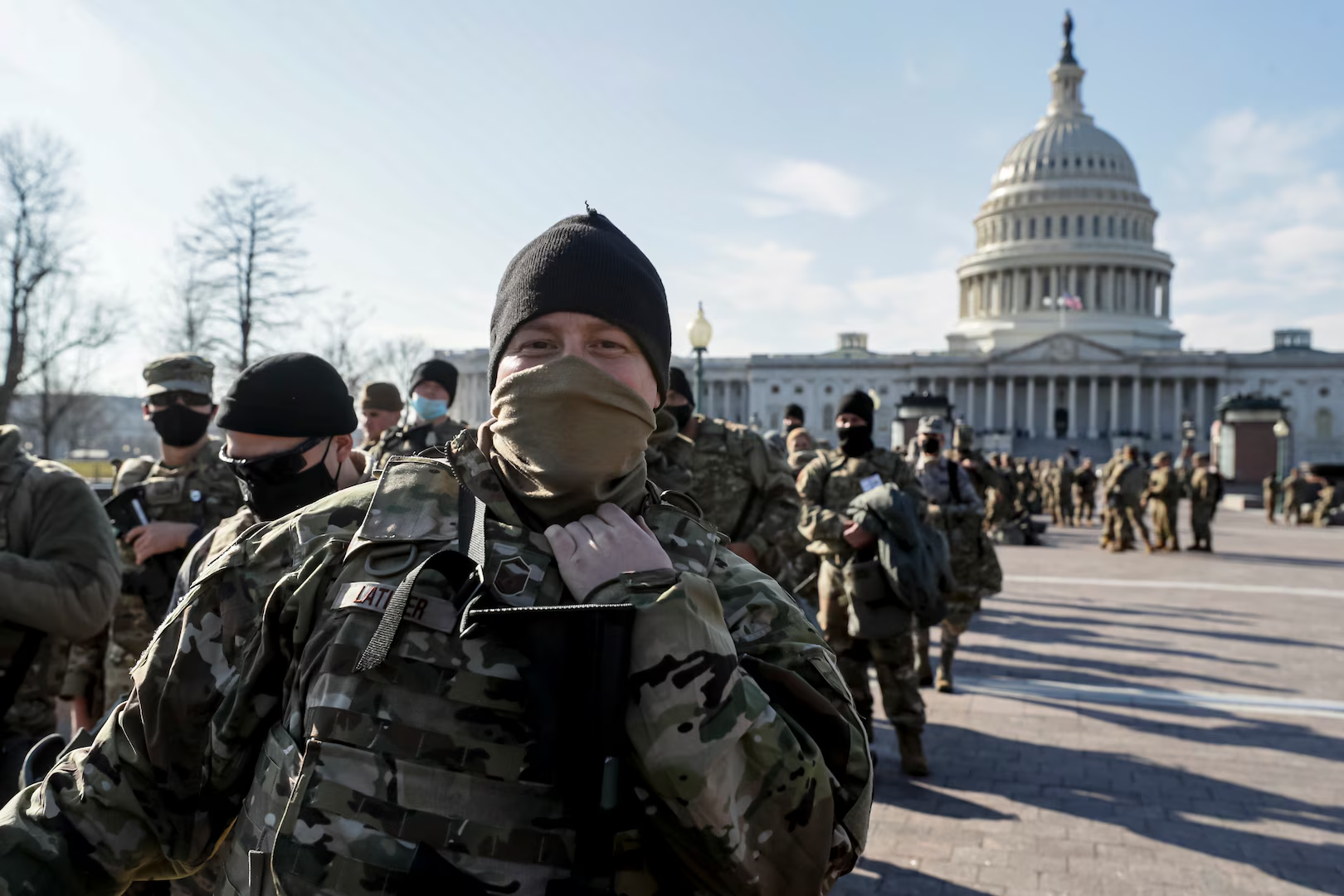

On August 11, 2025, President Donald Trump issued an executive order giving the federal government complete autonomy over the local police force within Washington, D.C. Later, another directive was enacted, placing members of the National Guard into active service to function as a peacekeeping force within the nation’s capital.
The purported motive of the mobilization is to maintain peace and combat violent crime in D.C., but critics allege it is a dangerous abuse of executive power. The move is one of many of Trump’s controversial mandates, which have been a staple of his second presidential term. Speaking to reporters as he left the White House, Trump stated, “We’re going to clean up our cities. We’re going to clean them up so they don’t kill five people every weekend. That’s not war, that’s common sense.”
Violent crime in Washington, DC, has been a significant concern in recent years, peaking in 2023. However, crime indexes published by the Metropolitan Police Department (MPDC) have shown that crime has fallen since then, reaching its lowest levels in 30 years. This decline has led many to question the necessity of deploying National Guard troops to the city. Even so, it is worth acknowledging that while crime has lessened in recent years, for many, crime is still concerning and affects daily life.
The polarizing effect of deploying these troops reveals itself in the arguments of individuals from opposite ends of the political spectrum, with supporters on the right agreeing with his mandate, saying it is a necessity for the safety of American citizens, while critics on the left question the efficiency and legality of the executive order. At EA, the community is similarly divided.
Jackson Nerney ’28 is a stout advocate of this mandate, saying, “I think this is needed and more useful than other spending, such as DEI, low-income housing, and environmental efforts.” Meanwhile, Luke Wright ’29 stands in firm opposition to the deployment, arguing, “It’s extremely unfair and unjust. I don’t think it should be happening. I think it’s a bad, very bad government decision. [Trump’s] leadership style is extremely immature, in that he thinks that just by silencing people, their voices, their ideas, and their opinions will just disappear, instead of actually addressing what they want to happen and fixing it that way.”
Math teacher and advisor of the Young Democrats club, Tracy Motley, had firsthand experience with the DC deployments. “It was very unsettling,” she recalls. “I arrived at Union Station, and the National Guard was just walking around. There were a few trucks out there, and I just felt uncomfortable. I don’t believe in having police states.”
Yet another point of contention comes from Trump’s threats to deploy the troops to other major American cities. Chicago Mayor Brandon Johnson, a Democrat, criticized Trump’s threats, calling them “beneath the honor of our nation,” and accused him of wanting to “occupy our city and break our Constitution.” Some EA students are concerned about this prospect of deployments in cities such as Philadelphia. “This is very worrying to me, especially since we live so close to a major city,” says Lola Aronchick ’29.
Law experts are similarly divided on the legality of the deployment. In a California case challenging the deployments, Judge Charles Breyer described the administration’s actions as a “serious violation of the Posse Comitatus Act.” On the other hand, Steve Vladeck, a Georgetown law professor, expressed the belief that Trump may hold legal ground. “The president does have the authority under certain laws (like the Insurrection Act) to deploy the military domestically in serious situations,” he argues.
Amid ongoing legal challenges, the discussion regarding federal power, local governance, and civil rights continues, with broad ramifications for the future of the country. The Trump administration maintains that the deployment is vital for public safety, whereas opponents contend it establishes a perilous precedent. Organizations such as the ACLU caution that the action may weaken democratic principles, labeling it a federal power overreach.
Despite a deepening American divide, there is agreement over one thing: the deployments represent a major moment in American history. The question is whether it will be looked back on as a moment when the country finally stood up to crime, or as another instance of Trump abusing his power and putting further stress on American democracy.